Right now, your body is performing thousands of tasks you aren’t even aware of. Every breath, every heartbeat, and every thought depends on a complex, internal network. To truly grasp the functions of all 11 organ systems in the human body, you have to stop looking at the body as a collection of separate parts. Instead, think of it as a coordinated team working 24/7 to keep you in balance.
At Dr. Chaitanya’s Pain & Multispeciality Hospital in Hyderabad, we frequently see patients who are surprised that a pain in one area is actually rooted in a completely different system. When you understand how these systems overlap, health concerns become much easier to navigate.
What Exactly Is an Organ System?
An organ system is simply a group of organs collaborating to handle a major life function. No system is an island. If one struggles, others usually pick up the slack or begin to show symptoms. Taking a “whole-body” perspective is the only way to provide effective medical care.
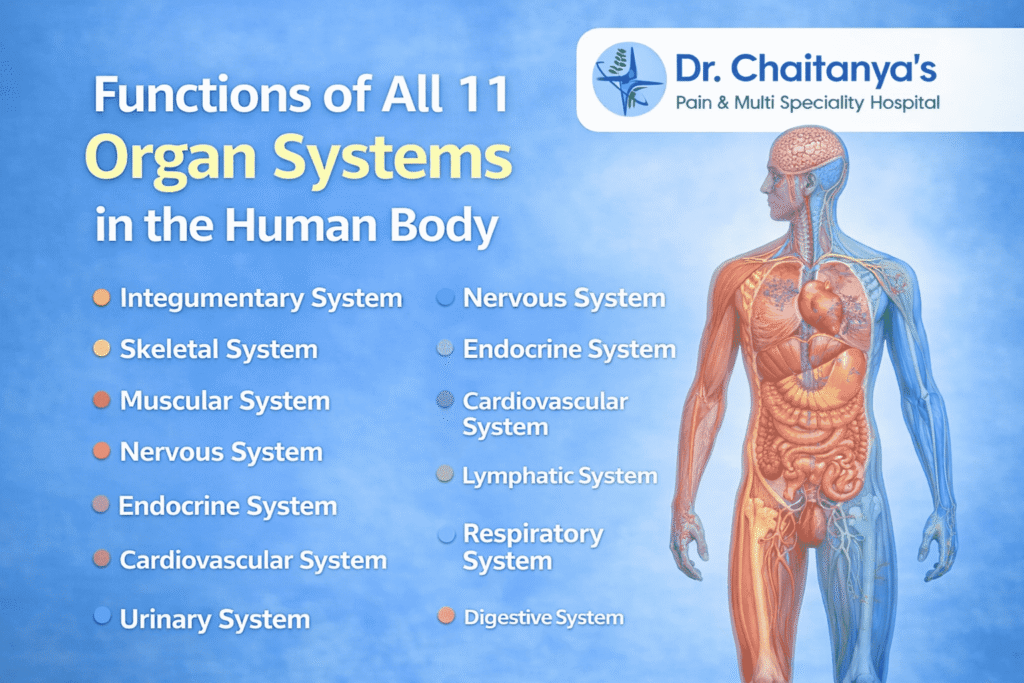
Here is a practical breakdown of the functions of all 11 organ systems in the human body and how they impact your daily life.
- The Integumentary System (Your Shield)
This is your skin, hair, nails, and sweat glands. It’s far more than just a covering; it’s your first line of defense against the outside world.
- Main Job: Blocking infections, regulating your temperature through sweat, and acting as a massive sensory map for touch and pain. It also helps synthesize Vitamin D.
- The Skeletal System (The Framework)
Your 206 bones do a lot more than just keep you upright.
- Main Job: Beyond providing structure, your bones protect your heart and brain, store essential minerals like calcium, and actually manufacture your blood cells inside the marrow.
- The Muscular System (The Engine)
This system is responsible for every movement, whether you choose it or not.
- Main Job: It handles voluntary movement like walking, but also involuntary actions like your heartbeat and the movement of food through your gut. It’s also your body’s primary source of heat.
- The Nervous System (The Command Center)
Comprising the brain, spinal cord, and nerves, this is the body’s high-speed communication network.
- Main Job: It sends electrical signals to coordinate movement, process what you see and feel, and manage your mood and memory. Nerve-related pain is a condition commonly seen in multispeciality care and can often be managed with appropriate treatment.
- The Endocrine System (The Chemical Messenger)
This system uses hormones to manage long-term changes rather than instant signals.
- Main Job: It regulates your metabolism, growth, sleep cycles, and stress responses. Hormonal imbalances may contribute to fatigue or changes in weight.
- The Cardiovascular System (The Delivery Service)
Your heart and blood vessels are the highway system of the body.
- Main Job: It pumps oxygen and nutrients to every cell while carrying away waste products like carbon dioxide. Poor circulation can sometimes contribute to slower healing.
- The Lymphatic System (The Cleanup Crew)
Often forgotten, this system is vital for your immune health.
- Main Job: It filters out toxins, produces white blood cells to fight infections, and manages fluid levels so you don’t experience excessive swelling.
- The Respiratory System (The Gas Exchange)
Breathing is about more than just lungs; it’s about oxygenating the blood.
- Main Job: It brings in oxygen and expels carbon dioxide. Because every organ needs oxygen to function, respiratory issues can quickly cause “brain fog” or muscle weakness.
- The Digestive System (The Power Plant)
This is where your body turns food into the fuel that runs the other 10 systems.
- Main Job: It breaks down nutrients for absorption and eliminates solid waste. Research suggests gut health may influence immune function and cognitive wellbeing.
- The Urinary System (The Filter)
Your kidneys and bladder act as a sophisticated water-treatment plant.
- Main Job: It filters the blood to remove liquid waste and maintains the perfect balance of electrolytes and water in your system, which is crucial for blood pressure control.
- The Reproductive System (The Future)
While its primary role is producing offspring, it also heavily influences your overall hormonal health.
- Main Job: It produces the sex hormones that affect everything from bone density to your energy levels and emotional well-being.
Why Connectivity Matters in Healthcare
When you look at the functions of all 11 organ systems in the human body, it becomes clear that “symptoms” are rarely isolated. Chronic pain in the back might be a skeletal issue, or it could be a nervous system compression or even a referred pain from an internal organ.
This is why we advocate for a multispeciality approach. At Dr. Chaitanya’s Pain & Multispeciality Hospital, we don’t just treat the spot that hurts; we look for the systemic connection.
Taking the Next Step for Your Health
Your body is an incredible, self-regulating machine, but professional evaluation can help identify underlying issues and guide appropriate care. Recognizing early signs of system imbalance can help address potential health concerns promptly.